A preschool came to us looking for a name.
That sounds simple—until you enter the preschool market and notice how crowded the naming space already is. Little this. Lil’ that. Colours, Kids, Tots, Buds. The same emotional territory, again and again.
The client wanted something different. A name that would be easy to say, easy to remember, and easy to recall. But more importantly, it had to rise above the clutter.
After exploring many directions, we arrived at Della Jr.
It was short. Distinct. Easy on the tongue. And unlike most preschool names, it did not try too hard to sound childish
That was the point.
Sometimes, a good name works because it refuses to become another voice in an already noisy room.
But not every naming story begins with clutter.

The school was Saraswati Global School. In Hindu mythology, Saraswati is closely associated with the peacock. The connection gave the scholarship a natural relationship with the school’s own identity.
We had a strong feeling about the name, so we asked the client for one thing: live with it for two or three days. Sometimes, a name needs a little time before its meaning settles in.
And it did.
Over time, Peacock Scholarship became a strong, memorable property of the school. It stood out, created curiosity, and could be explained with a story that belonged naturally to the institution. Eve with limited advertising budgets, the name had recall.
That experience reinforced something we deeply believe: a good name does not always need to feel familiar on day one. Sometimes, its very unfamiliarity is its strength.
The story of Kukdukoo began with another familiar naming problem.
The founders were planning a children’s literature festival and initially considered calling it NCLF—Noida Children Literature Festival.
The logic was understandable. Jaipur had its literature festival. Other cities had similar names. Gurgaon, Bangalore, Kanpur—many events were built around the same formula: city name plus literature festival.
But that was exactly the problem.
The name would have placed the festival inside a crowded category. Worse, it would have limited its future to one city. The festival was for children. It needed joy, curiosity, playfulness, energy—something children could respond to and adults could easily remember.
We explored names such as Gulluck and Pitara, among others.
But one name stayed at the top of our own wish list:
Kukdukoo.
The moment it appeared, it felt alive.
It was playful. Indian. Familiar. Almost impossible to say without hearing the sound in your head.

And most importantly, it had the freedom to travel beyond Noida.
The name was selected. Years later, Kukdukoo grew into one of the most recognised names in India’s children’s literature festival space.
Was that journey created by the name alone? Of course not.
But did the name give the brand a memorable beginning?
Absolutely.
Then came an online library.
Here, the emotion was completely different. This brand belonged to readers—the kind of people who disappear into books, live among stories, and happily become what we casually call bookworms.

From that emotional world came BukMuk.
That is something we often look for in naming: not just meaning, but personality.
And sometimes the right naming decision is not about creating something new. Sometimes, it is about stopping a brand from leaving behind something valuable.
Happy English School is nearly seven decades old. When the new generation took over the institution, there was hesitation around the old name. Perhaps “Happy English School” did not sound modern enough. So the school gradually started moving towards the shorter version—HES.
When we began working with them, we strongly disagreed with that direction.
For two reasons.
First, Happy English creates an emotion. It immediately suggests warmth, confidence, communication, and the possibility of a distinctive brand position.
HES does not.
Second, a school that has carried a name for nearly 70 years has something that cannot be designed overnight: legacy.

Giving that up simply to sound shorter or more modern would mean throwing away years of familiarity and recognition. Initially, the school team was reluctant.
But eventually, they returned from HES to Happy English.
Our view went one step further: perhaps even the word “School” was no longer necessary in everyday brand communication. Simply:
Happy English.
Like a title. Like a thought. Like a promise.
The Saraswati Global School journey later gave us another naming opportunity.
The school wanted names for its houses. But instead of simply creating four unrelated names, we wanted the nomenclature to continue the cultural world already being built around the institution.
The school had Saraswati in its name. It had the Peacock Scholarship. There was already an Indian cultural thread running through the brand.
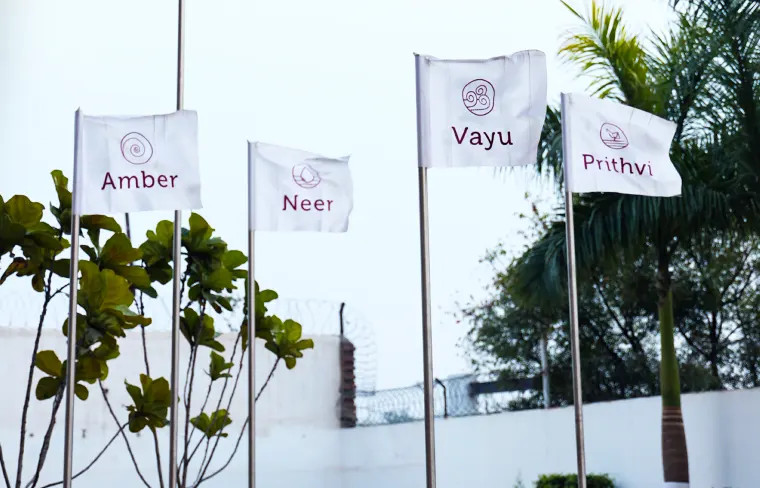
So we suggested a five-house structure built around:
Jal. Vayu. Neer. Amber. Prithvi.
The names felt simple, rooted, familiar, and connected to a larger idea. The client connected with the thought immediately, and the nomenclature was well received by students, parents, and other stakeholders.
Then there was Srjan.
Scholar Rosary School had been organising a large annual celebration for nearly two decades. It was colourful, energetic, creative, and full of student expression.

The event needed more than an annual-function title. It needed a name of its own. Something that could carry creation, expression, vibrancy, and energy. That thought led to Srjan. A short name, but large enough to hold an entire world of creativity within it.
And perhaps that is what all these stories have in common.
Della Jr. was about standing above clutter.
Peacock Scholarship was about finding a meaningful connection hidden inside the brand.
Kukdukoo was about freeing an idea from geography and giving it a joyful personality.
BukMuk was about capturing the spirit of readers.
Happy English was about protecting legacy and rediscovering the emotional power of an existing name.
Jal, Vayu, Neer, Amber, Prithvi were about building a connected cultural world.
And Srjan was about giving a long-running tradition an identity people could remember.
This is how we approach naming. We do not begin by opening a dictionary and making a long list of attractive words. We begin with questions.
What should this name make people feel?
What should they remember?
What does the brand stand for?
What story can the name carry?
Can it grow? Can people say it easily?
Can they recall it tomorrow?
And, most importantly, does this name truly belong to this brand?
Because a name may be only a word. But sometimes, that one word becomes the beginning of everything that follows.

